
Every woodworker eventually faces the same dull edge. Whether you push a hand plane across curly maple or guide a chisel through white oak, steel loses its crisp apex against wood fibers. The fix requires grinding away metal until two polished planes intersect cleanly. Yet walking into any workshop reveals sharp disagreements about the abrasive surface that should do the work. Some craftspeople swear by synthetic waterstones, while others rely entirely on steel plates coated in industrial diamonds.
Why does this debate persist? The short answer is that diamond plates and waterstones interact with tool steel in fundamentally different ways. One uses an immovable, incredibly hard mineral bonded to a flat steel slab. The other relies on a matrix of softer particles suspended in a binder that wears away as you work. Choosing between them is not about finding the single best tool in existence. It comes down to understanding how abrasive particles behave under pressure, how much time you want to spend maintaining your equipment, and what kind of steel sits in your tool rack.
How abrasive grit particles fracture during sharpening
What actually happens when steel rubs against an abrasive stone? To understand the process, picture scraping a cold stick of butter across coarse sandpaper versus dragging it across a bed of crushed gravel. Abrasives work by cutting tiny, microscopic grooves into steel. These individual cutting points are known as grit particles, and their behavior under friction dictates how fast a stone cuts and what kind of scratch pattern it leaves behind.
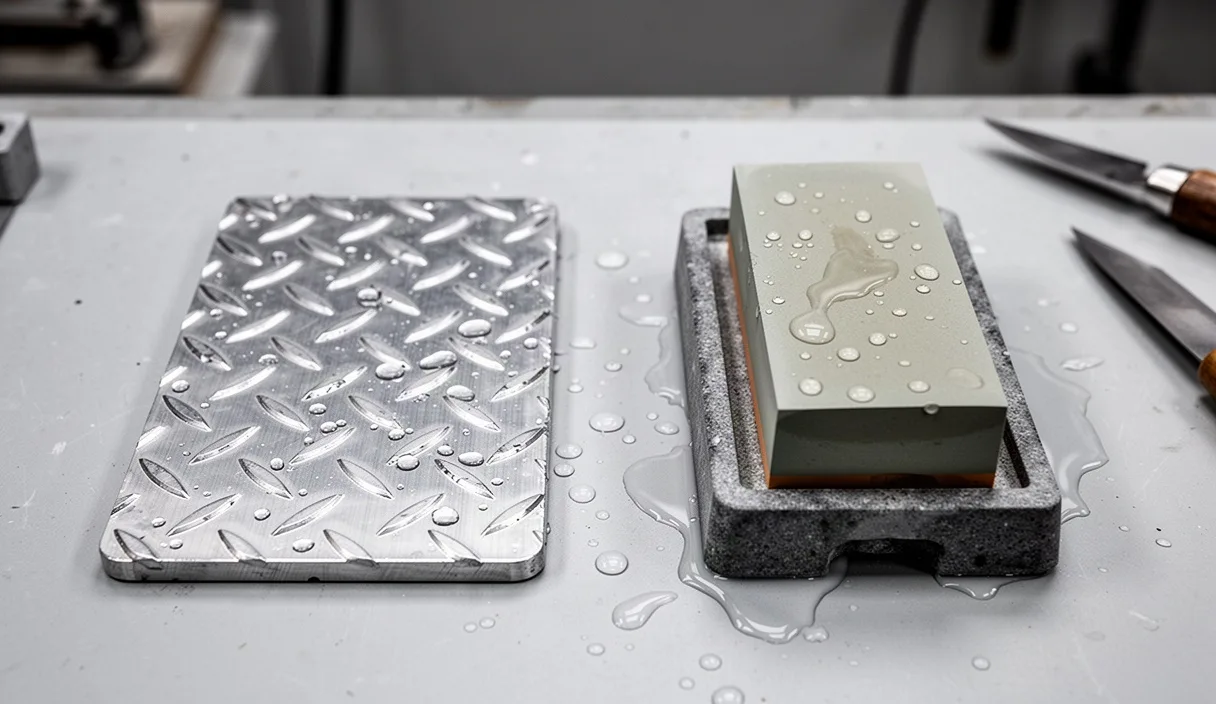
Diamond plates utilize monocrystalline or polycrystalline synthetic diamonds attached to a ground steel substrate by an electroplated nickel layer. Diamond is the hardest substance known, rating a 10 on the Mohs scale. Because tool steel is far softer than diamond, the diamonds do not fracture under normal hand-sharpening pressure. Instead, they act like rows of miniature plows. They gouge deep, consistent furrows through the steel. Over months or years of heavy use, these particles do not sharpen themselves; they either round off slowly or pull loose from the nickel bed entirely.
Synthetic waterstones behave in reverse. Most waterstones consist of aluminum oxide or silicon carbide particles held together by a resin, clay, or ceramic binder. As you rub the bevel of a chisel across the stone, the binder slowly breaks down from friction and water exposure. The dulling grit particles tear free from the surface, exposing brand new, razor-sharp particles underneath. This property is called friability: the tendency of an abrasive mineral to fracture and expose fresh cutting facets under stress.
Because the particles in a waterstone break down during use, they leave a scratch pattern that grows finer as the sharpening stroke progresses. A diamond plate maintains its exact particle size, meaning its scratch pattern remains fixed and distinct until the plate wears out.
Diamond plates: why guaranteed flatness saves setup time
Why do so many cabinetmakers keep a coarse diamond plate next to their bench grinder? The primary benefit is stability. A quality diamond plate begins as a solid billet of precision-ground steel or cast iron, machined flat to tolerances within 0.025 millimeters across its entire length. Because the diamonds do not wear away the underlying metal core, that dead-flat surface stays flat through hundreds of sharpening sessions.
Flatness matters because hand tools require flat reference surfaces. When you flatten the back of a bench chisel or the sole of a block plane, any hollow or bump on your abrasive will transfer directly to the tool. With waterstones, you must regularly rub the stone against a flattening medium to remove the dishing caused by uneven hand pressure. A diamond plate eliminates this flattening chore completely.
This permanent geometry makes diamond plates especially helpful for three workshop tasks:
- Flattening the backs of brand-new tools: New chisels often arrive with machining marks and slight twists that require extensive abrasive contact to correct.
- Conditioning softer waterstones: A coarse diamond plate, particularly around 300 to 400 grit, serves as an exceptional flattening tool for synthetic waterstones.
- Fixing nicked blades: Grinding out a chipped cutting edge requires aggressive stock removal, which would quickly gouge a deep rut into a standard waterstone.
Diamond plates also require minimal lubrication. A few squirts of tap water or non-corrosive lapping fluid are all you need to float away swarf, which is the fine slurry of abraded metal filings produced during sharpening. When you finish, you simply wipe the plate dry with a rag. There is no soaking, no truing of the surface, and no muddy reservoir to clean up.
Waterstones: how fresh slurry polishes cutting edges
If diamond plates stay flat and cut quickly, why does almost every high-end toolmaker finish their edges on waterstones? The answer lies in the slurry. Slurry is the milky mixture of water, abraded metal swarf, and freshly released grit particles that forms on top of a waterstone as you work. While a diamond plate holds each abrasive grain rigid, a waterstone allows grit particles to roll and crumble between the tool steel and the stone.
This rolling abrasive action softens the edges of the scratches. Instead of cutting deep, parallel valleys with steep ridges, the rolling slurry peens and buffs the steel surface. This action produces a mirror polish and leaves the very tip of the cutting edge smoother and less prone to micro-chipping under heavy grain resistance. A blade finished on an 8000-grit waterstone will push through end-grain cherry with noticeably less effort than a blade taken off an extra-fine diamond plate.
Waterstones also come in an immense range of grits. Diamond plates generally top out around 1200 to 8000 grit equivalent, and ultra-fine diamond plates are expensive and wear out faster than their coarse counterparts. Synthetic waterstones, by contrast, readily scale from coarse 220-grit shaping blocks up to 16000-grit finishing stones, with some specialty polishing stones reaching 30000 grit. At these extreme levels, the abrasive particles measure less than 0.5 microns across, refining the edge to surgical precision.
| Feature | Diamond Plates | Synthetic Waterstones |
|---|---|---|
| Surface Flatness | Guaranteed flat; never requires lapping | Dished with use; requires regular flattening |
| Abrasive Behavior | Rigidly bonded; scratches are uniform and deep | Friable; particles break down to create polishing slurry |
| Highest Available Grit | Typically 1200 grit (roughly 8000 mesh equivalent) | Readily available up to 16000 or 30000 grit |
| Lubricant Needed | Light water mist or lapping fluid | Submersion soaking or continuous splash of water |
| Initial Cost | Moderate to high per plate | Low to high depending on binder and grit |
Drying and maintenance routines to prevent surface damage
Both sharpening systems require specific care, though their failure modes are entirely different. Neglecting a diamond plate leads to rust and bond degradation, while neglecting a waterstone leads to cracking, dishing, or fungal growth.
For diamond plates, water is an enemy if left stagnant. The backing plate is usually steel. While the nickel plating shields most of the surface, tiny pinholes in the plating can allow water to reach the raw iron core beneath. If rust forms under the nickel, it pushes the nickel layer away, causing large sheets of diamond grit to flake off. After every sharpening session, spray the plate with clean water to remove acidic swarf, scrub it with a nylon bristle brush, wipe it dry with a towel, and let it air-dry completely on edge. A light wipe with camellia oil or mineral oil will safeguard the plate during humid summer months.
Waterstones demand a strict regimen of flattening and controlled drying. Because the center of the stone sees more strokes than the ends, a waterstone dishes out after just a few blades. You should flatten your waterstone frequently, ideally at the start of every session or after sharpening two tools. Rubbing the wet stone across a dedicated flattening plate or coarse silicon carbide paper on glass ensures the surface remains true.
When storing waterstones, follow these rules based on the binder type:
- Splash-and-go stones (hard ceramic or resin): Never soak these stones permanently in water. Submerging them breaks down their binder, making them mushy. Splash water on the surface, work, rinse clean, and air-dry away from direct sunlight or drafts.
- Soaking stones (clay or porous binders): These stones must absorb water for 10 to 20 minutes before use. If you keep them in a permanent water bath, add a drop of mild dish detergent or a splash of bacteriostat to prevent mildew, and change the water regularly.
- All waterstones: Never let a wet stone freeze. Freezing water expands inside the micro-pores of the stone, causing it to split in half instantly. Keep them in a heated space during winter.
Choosing based on your tool steels and bench space
Which system belongs in your workshop? The answer depends heavily on the tools you own and where you work. A carpenter working out of a truck on job sites has vastly different needs than a chairmaker working in a dedicated, climate-controlled studio.
Consider the steel inside your cutting irons. Traditional carbon steels, like O1 or Japanese white paper steel, have a simple molecular structure with fine iron carbides. These steels sharpen rapidly on almost anything. They respond beautifully to waterstones, yielding an edge so sharp it can shave arm hair with zero downforce. Waterstones cut these traditional alloys swiftly without loading up.
Modern high-alloy tool steels, such as A2, D2, and powder-metallurgy alloys like CPM-3V or CPM-MagnaCut, contain large, tough chromium and vanadium carbides. Vanadium carbides are harder than the aluminum oxide particles found in traditional waterstones. When you rub an A2 blade against a soft waterstone, the stone's particles often slide off the vanadium carbides rather than cutting them cleanly, resulting in slow progress and rapid dishing of the stone. Diamond plates make quick work of these hard, modern alloys because diamond easily cuts through every carbide known in metallurgy.
Bench space and mobility also play a major role:
- The mobile woodworker: Diamond plates are unbreakable, thin, light, and need only a small spritz bottle of water. You can toss them into a canvas tool roll without worrying about chipping their corners.
- The compact bench: Waterstones require water trays, pond basins, and drainage towels to prevent your workbench top from warping due to moisture. If your workspace cannot tolerate water splashes, diamond plates or dry diamond films are a cleaner choice.
- The dedicated sharpening station: If you have room for a permanent sink or a waterproof sharpening pond, waterstones reward your investment with edges that cut cleaner in hardwoods and leave a glass-like surface on the wood.
A practical progression from coarse shaping to fine polish
Many experienced craftspeople do not choose one system exclusively. Instead, they combine both to exploit their individual strengths. Using a coarse diamond plate for shaping followed by medium and fine waterstones for edge refinement provides speed, flatness, and polish without wasted effort.
Here is an effective sharpening sequence using both media:
Grinding the primary bevel
When an edge has deep chips or the bevel angle needs adjustment from 30 degrees down to 25 degrees, use a coarse diamond plate around 300 grit. Keep the blade steady and use long strokes down the length of the plate. Because the diamond surface does not hollow out, your primary bevel stays dead flat. Continue until you raise a continuous burr across the entire back edge of the tool.
Refining the scratches
Move to an intermediate stone, such as a 1000-grit synthetic waterstone. Splash clean water across the stone. Work the bevel until all coarse scratches from the 300-grit diamond plate disappear. The waterstone will cut rapidly while softening the jagged ridges left by the diamond. Flip the tool over and take two light, flat strokes across the back to manage the burr.
Creating the micro-bevel and final polish
Transition to an ultra-fine waterstone, ideally 6000 to 8000 grit. Raise the angle of the blade by roughly 2 degrees to target the very apex of the cutting edge, creating a micro-bevel. Take 5 to 10 steady pulls. A creamy slurry will develop, burnishing the steel. Finally, lay the back of the tool completely flat on the stone and pull it backward several times to remove the foil burr entirely. The cutting edge should now cleanly push-cut across end-grain softwood without tearing the fibers.
Common mistakes
Even with quality equipment, incorrect technique can ruin your sharpening surfaces or blunt your edges. Watch out for these four frequent errors:
- Pressing too hard on diamond plates: Pushing down with excessive force does not speed up metal removal. Instead, it strips the diamond grains right out of their electroplated nickel matrix, permanently creating bald, smooth spots on the plate. Let the weight of your hands do the work.
- Sharpening on a dished waterstone: Working on a hollow stone rounds the back of your chisels. Once the back of a chisel becomes convex, the tool cannot register flat against wood for paring cuts, requiring hours of regrinding to repair.
- Cross-contaminating grits: Moving from a 400-grit plate directly to an 8000-grit stone without washing your hands and wiping the blade carries coarse grit onto the fine stone. One rogue 400-grit particle embedded in an 8000-grit stone will leave deep scratches across your polished edge.
- Using excessive water on diamond plates: Flooding diamond plates can cause water to pool beneath the base, encouraging oxidation. A light mist is all that is required to clear swarf.
Getting started in your workshop
If you are setting up your first serious sharpening kit, do not overcomplicate the process. Begin by inspecting the tools you use most frequently. If your cabinet contains mostly vintage carbon-steel bench planes and chisels, a double-sided 1000/6000-grit synthetic waterstone paired with an inexpensive flattening plate will deliver razor edges for a modest investment.
If you work with modern, cryogenically treated A2 or powder-metal plane irons, invest first in a double-sided diamond plate with coarse (roughly 300 to 400 grit) and fine (roughly 1000 to 1200 grit) surfaces. This plate will handle initial grinding, primary bevel maintenance, and back-flattening without ever needing maintenance itself. When you want to push your edges to an exhibition-grade polish, add a single 8000-grit splash-and-go waterstone to your bench. Use the diamond plate to keep the waterstone flat, wash your blades between grits, and let the steel tell you when it is ready to cut wood.